
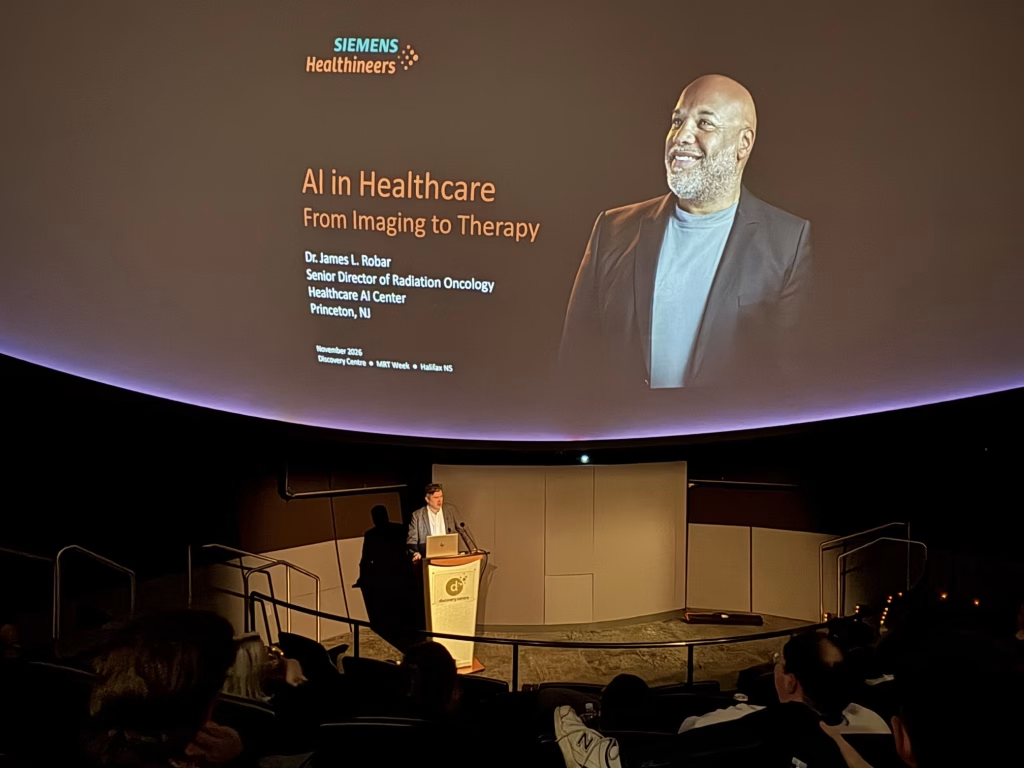
I recently attended a presentation called AI in Healthcare: From Imaging to Therapy, given by Dr. James Robar, Senior Director of Radiation Oncology at Siemens Healthineers’ Healthcare AI Center. This post is based on my notes from that session and looks at what AI in healthcare could mean for service design.
The presentation gave an overview of how AI is being applied across the healthcare journey, from early detection and medical imaging through diagnosis, treatment planning and therapy.
AI is already being used to reconstruct MRI images faster, support clinicians in identifying abnormalities and reduce the time required for parts of radiation therapy planning. When these capabilities begin working together across a patient’s journey, the outcomes extend beyond individual tasks.
From individual tasks to service design
One of the concepts presented was “orchestration across the system.” The healthcare journey was described in three broad stages: patient to image, image to report or plan, and report or plan to treatment. AI can potentially play a role across all three.
If AI is viewed as a way to automate individual tasks, the focus tends to be on creating efficiency. Can a task be done faster? Can manual effort be reduced? Can AI support work traditionally done by a clinician?
From a service design perspective, there is a larger question: If the time and effort required for parts of a service change significantly, how should the service itself change?
If an MRI examination can happen faster, it could mean more people can use the same machine in a day. More capacity can affect scheduling, wait times and how quickly patients move from referral to diagnosis and treatment.
Giving patients their time back
While healthcare focuses on delivering outcomes, patients spend a significant amount of time interacting with the healthcare system: Waiting for appointments. Travelling to appointments. Sitting in waiting rooms. Waiting for results. Waiting for another appointment. Waiting for treatment to begin.
If technology can safely (more on this later) reduce some of that time, the value isn’t only operational efficiency; it’s also the time given back to patients. That could mean receiving a diagnosis sooner, starting treatment earlier, spending less time undergoing imaging or treatment, or even making fewer trips to a hospital.
There could also be a system-level benefit; if reducing the time required for a procedure allows more people to be treated using the same equipment and clinical resources, it could improve throughput and access for patients who are still waiting for care.
Designing around different constraints
The presentation also explored concepts such as patient twins and operational twins. An operational twin could look at the relationships between patients, clinicians, equipment, scheduling and capacity rather than optimizing one clinical activity at a time. That shifts the focus from individual task automation towards coordinating the service as a whole.
Healthcare services operate within constraints: limited clinical capacity, expensive equipment, specialist availability, the time required to interpret information and the time required to plan and deliver treatment.
If AI changes some of those constraints, simply inserting it into an existing process may leave much of the potential benefit unrealized.
Some activities may no longer need to happen in the same sequence. Work currently spread across several appointments could potentially be brought together. Capacity could be allocated differently. Patients could spend less time moving through the system. These are service design questions.
Keeping people in the system
Clinical judgement, safety, trust, accountability and patient experience all need to be considered along with faster delivery. The presentation reinforced the continued role of clinical oversight, particularly as AI becomes involved in more consequential decisions. How should the work and responsibilities be divided or shared between people and technology?
If AI can perform some forms of analysis or planning quickly, where does clinical expertise need to remain central? Where should clinicians retain control? Where can automation safely reduce work that does not require their attention?
From the patient’s perspective, human interaction remains a critical part of the experience.
Those factors need to be designed into the service.
When the constraints change, the service can change
I went to the presentation expecting to hear about AI in medical imaging and treatment. While I learned a lot about how AI is being developed and trained for healthcare applications, I left thinking more broadly about how healthcare services could change with AI capabilities.
A faster MRI isn’t only a faster MRI. Faster treatment planning isn’t only a more efficient planning process. If patients can be diagnosed earlier and the system can plan faster, use clinical resources more effectively and increase the number of people who can move through the system, some of the constraints around which healthcare services were designed begin to change.
When those constraints change, we have an opportunity to reconsider the service around them.
Leave a Reply